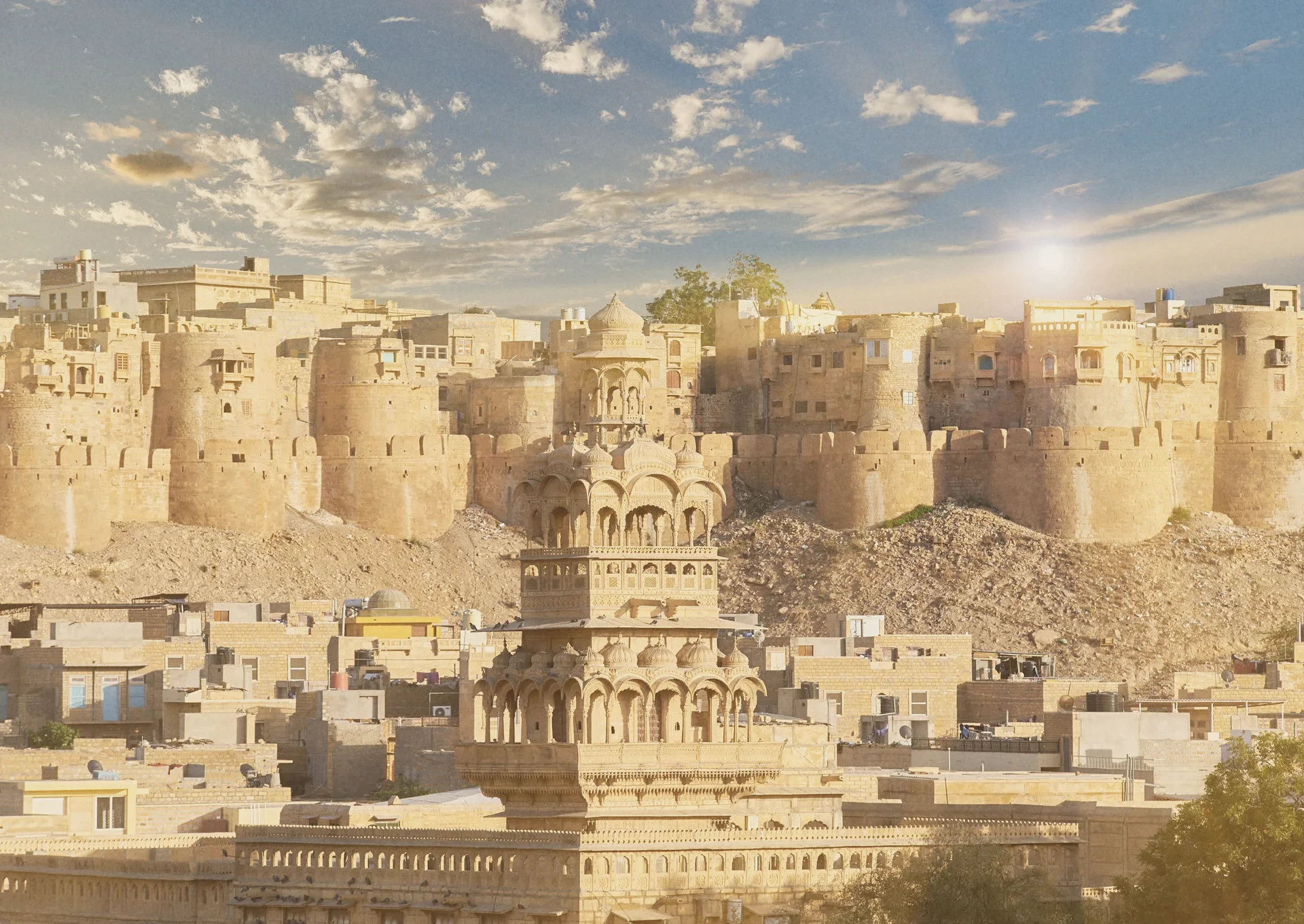
Royal Rajasthan
Palace Hotels, Tiger Safaris & the Taj Mahal
This is the India of your imagination—and so much more. From the pink-hued walls of Jaipur to the blue labyrinth of Jodhpur, from tiger-stalked forests to the ethereal beauty of the Taj Mahal at sunrise, this journey weaves together palace hotels, ancient forts, and moments of pure magic. Every night, you'll sleep where maharajas once held court. Every day, you'll discover why Rajasthan is called the Land of Kings.
This itinerary is a starting point. Every element can be adjusted—add days, change hotels, swap experiences, alter the pace. We'll craft the final journey around your preferences, travel dates, and dreams.
Your Journey Unfolds

Arrival in Delhi
Your journey begins in Delhi, where ancient and modern India collide in spectacular fashion. After clearing customs, you'll be met by your private guide and whisked to your hotel—a quiet sanctuary after the sensory symphony of the city.
Delhi has been destroyed and rebuilt seven times over three millennia. Each empire—Mughal, British, Indian—left its mark. Tonight, as you rest, know that you're in a city that has welcomed travelers for longer than most nations have existed.
Stay: The Imperial or The Oberoi, New Delhi

Old Delhi & New Delhi
A full day to explore India's capital. Morning in Old Delhi—the narrow lanes of Chandni Chowk, the grandeur of the Jama Masjid, the solemnity of Raj Ghat where Gandhi was cremated. Afternoon in New Delhi—Humayun's Tomb, the India Gate, and the geometric perfection of Lutyens' colonial architecture.
Humayun's Tomb, built in 1570, was the first garden tomb in India and the inspiration for the Taj Mahal. Stand before it and you're seeing the blueprint for the world's most famous monument of love—built 70 years before Shah Jahan broke ground in Agra.
Stay: The Imperial or The Oberoi, New Delhi

Train to Jaipur
Board the Shatabdi Express for the scenic journey to Jaipur. As the train pulls into the Pink City, you'll understand why this color was chosen—originally painted to welcome Prince Albert in 1876, and maintained ever since by municipal law.
Maharaja Sawai Ram Singh II ordered the entire old city painted pink—the color of hospitality in Rajput culture. It was meant for one royal visit, but the people loved it so much that Jaipur has been pink for nearly 150 years.
Stay: Oberoi Rajvilas or Taj Rambagh Palace

Jaipur: Forts & Palaces
Ascend to the Amber Fort by Jeep, wandering through halls of mirrors and gardens that seem to float. Afternoon at the City Palace, still home to Jaipur's royal family, and the Hawa Mahal—the Palace of Winds with its 953 windows.
The Sheesh Mahal (Hall of Mirrors) at Amber Fort was designed so that a single candle, reflected infinitely, could illuminate the entire room like a starlit sky. The craftsmen who created it used mirrors from Belgium—carried overland by camel.
Stay: Oberoi Rajvilas or Taj Rambagh Palace

Jaipur to Ranthambore
Drive through the Rajasthani countryside to Ranthambore, one of India's premier tiger reserves. Check into your luxury jungle lodge, surrounded by the calls of peacocks and the whisper of possibility—will tomorrow bring a tiger?
Ranthambore was once the private hunting ground of Jaipur's maharajas. Today, it's a sanctuary where perhaps 80 tigers roam among the ruins of a thousand-year-old fort. The same forests where royalty once hunted now protect some of India's most endangered royalty.
Stay: Aman-i-Khás or Oberoi Vanyavilas

Tiger Safari
Dawn and dusk safaris into the park. In open-top vehicles, you'll track tiger footprints through the undergrowth, past lakes filled with crocodiles, beneath a fort where leopards make their home. Every rustle in the grass could be the moment.
The tigers of Ranthambore are famous for their boldness—they've been photographed lounging on the steps of ancient temples, walking through fort ruins, even swimming in lakes. They've reclaimed this landscape from history itself.
Stay: Aman-i-Khás or Oberoi Vanyavilas

Ranthambore to Udaipur
A longer drive today, but through landscapes that shift from jungle to farmland to the Aravalli Hills. Arrive in Udaipur as the sun sets over Lake Pichola, turning the City of Lakes into liquid gold.
Udaipur was founded in 1559 by Maharana Udai Singh II after a holy man told him this valley, protected by hills and blessed with lakes, would never fall to invaders. He was right—Udaipur is the only major Rajput city never conquered by the Mughals.
Stay: Taj Lake Palace or Oberoi Udaivilas

Udaipur: Venice of the East
A day to fall in love with India's most romantic city. Morning at the City Palace—a marble fantasy rising from the lake. Afternoon wandering the old town's winding lanes, browsing miniature paintings and silver jewelry. Evening: a private dinner on the lake.
The Taj Lake Palace, floating white marble in the center of Lake Pichola, was built as a summer pleasure palace in 1746. It appeared in the James Bond film "Octopussy"—but the real romance is reserved for those who stay overnight, watching the city lights reflect off the water.
Stay: Taj Lake Palace or Oberoi Udaivilas

Udaipur to Jodhpur
Cross the Aravallis once more, arriving in Jodhpur beneath the shadow of Mehrangarh—one of India's largest and most impressive forts, rising 400 feet above the Blue City.
Why is Jodhpur blue? Some say the color keeps houses cool. Others say it repels insects. The most poetic explanation: it marks the homes of Brahmins, the priestly caste. The truth is probably all three—and none of it matters when you see an entire city drenched in azure.
Stay: RAAS Jodhpur or Umaid Bhawan Palace

Jodhpur: The Blue City
Morning exploring Mehrangarh Fort—its treasures, its views, its stories of battles and betrayals. Walk the blue lanes of the old city, stopping for lassi at a shop that's been serving it for generations.
Mehrangarh's foundations include a terrible secret: a man named Raja Ram Meghwal was buried alive in the foundations to bless the fort. His family, in compensation, has lived rent-free in houses below the fort for 500 years. Jodhpur keeps its promises.
Stay: RAAS Jodhpur or Umaid Bhawan Palace

Jodhpur to Agra
An early flight to Agra via Delhi. Afternoon at the Agra Fort, red sandstone walls enclosing palaces where Shah Jahan spent his final years—imprisoned by his son, gazing at his beloved Taj Mahal across the river.
Shah Jahan planned to build a black marble twin of the Taj Mahal on the opposite riverbank, connected by a bridge. His son Aurangzeb imprisoned him before he could begin. For eight years, the emperor could only watch his wife's tomb from a window.
Stay: The Oberoi Amarvilas

Taj Mahal at Sunrise
Wake before dawn for the moment you've been waiting for. Enter the Taj Mahal as the first light hits white marble and turns it pink, then gold, then blazing white. You'll have time to explore every angle, every inlaid flower.
The Taj Mahal took 22 years and 20,000 workers to build. The marble came from Rajasthan, the jade from China, the turquoise from Tibet. It is not just a monument to love—it is a monument to the idea that some things are worth everything.
Stay: The Oberoi Amarvilas

Departure
Return to Delhi for your onward flight. If time allows, there may be space for last-minute shopping in Khan Market or a spa treatment before heading to the airport.
There's a saying in Rajasthan: "Padharo mhare desh"—welcome to my land. It's not just a greeting; it's an invitation to return. Those who accept find that each visit reveals new layers. This is not goodbye. It's "see you again."
Stay: Day use room available
Ready to Begin?
This journey is waiting to be shaped around you. Tell us your dates, your preferences, your dreams—and we'll craft something extraordinary.